
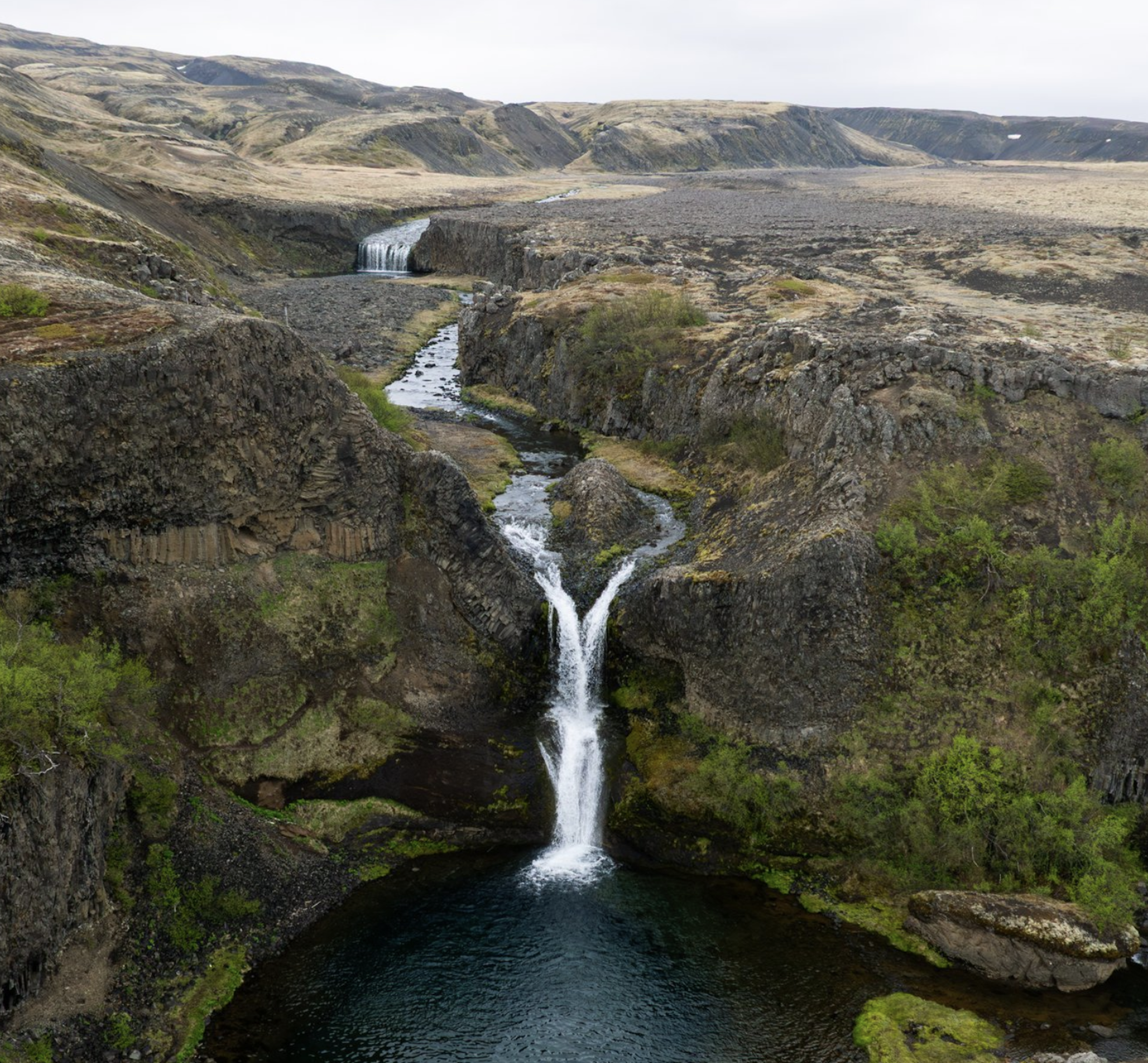
Þjórsárdalur is a valley in South Iceland, just off the Golden Circle and about an hour and a half from Reykjavík. It holds Háifoss, one of the country's tallest waterfalls, the twin falls of Hjálparfoss, the green gorge of Gjáin, and Viking-age ruins at Stöng. Road 32 runs the length of the valley and the sights sit close together, which makes it an easy day trip or a half-day detour.


One of the easiest detours in South Iceland
The Golden Circle covers Iceland's greatest hits. Carry on a little past Gullfoss and the landscape turns wilder, the roads get quieter, and the crowds thin out. By the time you reach Þjórsárdalur, running along Þjórsá, Iceland's longest river, you have arrived at the edge of the highlands.
The valley sits a short drive from both the Golden Circle and the Ring Road, which makes it one of the simplest additions to an Iceland itinerary. You can fit it around Gullfoss and Geysir, pick it up on the way east toward the south coast, or drive out from Reykjavík and be back the same evening. It is a change of route rather than a change of plan.
What you get for it is a valley of waterfalls, Viking ruins, and open highland country, with fewer people around than at the famous stops. People have been stopping here for a thousand years. It is somewhere Icelanders still head with family or friends on a summer weekend, less a sightseeing stop than a day out.
How to get there
From Reykjavík, it is roughly 130 km and about an hour and a half by car.
From the Golden Circle, it is shorter. Leave Gullfoss or Geysir, follow roads 35 and 30 south, then turn onto road 32, which runs the length of the valley and links most of the sights. Coming along the Ring Road instead, turn north onto road 30 east of Selfoss. Either way, you'll probably arrive in under an hour.
Road 32 is straightforward in a regular car. Some of the side roads are not. The tracks out to the waterfalls and other sights are often gravel and some can be potholed. Check road.is before you set out, check what your rental allows if that applies to you, and allow more time outside summer, when conditions get rougher.
What to see in the valley


Hjálparfoss
Probably the easiest stop, and a good first one. Two streams drop side by side into a single pool, framed by basalt columns that look like someone knocked over a pile of firewood. The walk from the car park takes a few minutes.
The name means "the helping falls." It comes from the surrounding area, Hjálp, named by travelers coming down off Sprengisandur, the highland desert in the middle of the country. This area in Þjórsárdalur is where the ground turns green again, and where the horses of tired travelers finally got something to eat. A place named after relief says a fair amount about what the journey was like.

Gjáin
Gjáin is a small green gorge with waterfalls, basalt columns, and clear pools. The Rauðá river runs through it and falls into the gorge as Gjárfoss. Everything is smaller than you expect, and that is part of the appeal.
This is where Gaukur of Stöng and Þuríður of Steinastaðir used to meet in secret. The story goes that when she heard he had been killed, she ran up here and wept on one of the slopes, and snow has never settled on it since. If you make it out here on a snowy day, you can see for yourself whether the story holds up.
The walk down into the gorge is short, but steep in places and loose underfoot. Allow time to wander once you are down there.
Gjáin, Háifoss, Granni, and Hjálparfoss have all been protected since 2020, so stay on the paths. The plants here take decades to grow back.
Film crews found it too. Gjáin and the ruins at Stöng both appear in Game of Thrones.


Stöng and the Commonwealth Farm
This is one of the easiest places in Iceland to see real Viking ruins, and the reason they survived is not a happy one.
In 1104, Hekla volcano erupted and buried the farms in Þjórsárdalur under ash. One of them was Stöng. The ruins were excavated in 1939 and are among the best-preserved remains of a Viking-age farmhouse in Iceland. The eruption destroyed the farm, but the ash that buried it also sealed it, which is why so much of it is still there to see.
At Stöng you can view the actual floor plan from a walkway by the surrounding stones. To actually walk into one of these houses, carry on to the Commonwealth Farm (Þjóðveldisbærinn), a full-scale reconstruction built from the Stöng excavation. You can go inside: turf walls, a long fire pit running down the middle of the hall, and a ceiling far higher than most people expect of a turf house. It is about as close as you can get to standing in someone's home from a thousand years ago.
The floor plan is Stöng's, but the height of the rooms and everything in them had to be worked out from written sources, comparable buildings, and, where the evidence ran out, imagination.

Háifoss and Granni
Fossá drops 122 meters into a canyon here, which makes Háifoss one of the tallest waterfalls in Iceland. Granni falls beside it, and the name means what it sounds like it should: neighbor. You see both from the viewpoint at the canyon rim.
It is the furthest point in the valley, and worth the extra driving. The drop is in front of you and the highlands open up behind. There are not many places in the world where you get both at once.
If the view looks familiar, that is because the Stranger Things finale ends here.
When to go and how long to stay
June through September is the reliable window, and generally the safe bet anywhere in Iceland. Even then, anything can happen, which is part of the charm. The roads are open, the valley is at its greenest, and daylight is generous enough that you can arrive late in the afternoon and still see everything. September brings color to the birch woods and far fewer cars.
The shoulder seasons and even winter can work too. They just take more preparation and more time.
Bring proper shoes, water, and layers. It is worth packing a lunch or something to snack on as well. The valley rewards people who linger, and there are plenty of good spots to sit down by the water and make an afternoon of it rather than moving straight on to the next stop.
Can you stay in Þjórsárdalur?
At the moment, in 2026, the valley is a day trip. Most people visit from Reykjavík, from a base along the Golden Circle, or on the way to or from the south coast.
That is changing. A new destination is being built in the valley. The first cabins are due to open in the summer of 2027, with the Mountain Baths, a visitor center, and a hotel set into the mountainside to follow. For now, come for the day. Before long there will be a reason to stay the night.
Þjórsárdalur and the Golden Circle: common questions
Is Þjórsárdalur worth adding to a Golden Circle trip?
Yes, if you have half a day it’s well worth it. It sits a short drive from the route and gives you a different kind of landscape: taller waterfalls, a green gorge, and Viking-age ruins, usually with fewer people around.
Can you do the Golden Circle and Þjórsárdalur in one day?
Yes. Most people do the Golden Circle in the morning and turn south afterward, which gets you into the valley by early afternoon with time for the main stops. A little planning helps: an early start, and a decision about which stops matter most to you.
Is Þjórsárdalur better than the Golden Circle?
They do different things. The Golden Circle gives you the classic route to some of Iceland's most-visited sights. Þjórsárdalur gives you more green, more space, and Viking-age history.
How far is Þjórsárdalur from Gullfoss?
About an hour by car. From Gullfoss waterfall, head south on roads 35 and 30, then turn onto road 32, which runs into the valley.
Can you visit Þjórsárdalur instead of the Golden Circle?
You can, and it makes a good day out on its own. Many visitors do both, since they are close enough that skipping one is not really necessary.
